
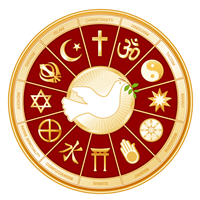
 Today I’m pleased to interview James Morrison, a world religion teacher at a public high school in Red Wing, Minnesota. He has taught world religion for the last 18 years and blogs about his experiences at teachnotpreach.com. He is currently writing a book on the question, “What (if anything) should public schools teach children about religion?”
Mr. Morrison personally is not a Christian; he identifies himself as a “skeptical deep-thinking seeker of truth and knowledge.” I am not interviewing him here for a Christian perspective. On the contrary, I am interested in hearing a non-Christian perspective on how the faith of Christian teenagers fares in a world religion class setting. In Mr. Morrison’s experience, the faith of his Christian students often gets rocked.
So why a non-Christian perspective? As I’ve blogged about before, nearly two-thirds of 20-somethings who were raised in Christian churches are turning away from faith. The research shows that intellectual barriers are the predominant issue. Kids are having trouble seeing how their faith fits and doesn’t fit with the world around them. A world religion class taught by a non-believer typifies the setting that is challenging many Christian kids today.
My hope is that this post challenges all of us to consider how our own kids would fare in a class of this nature, faced with viewpoints of this nature, and what impact that should have on how we raise our kids to have confident faith.
Mr. Morrison, can you start by describing a basic outline for your class? What topics do you cover?
The course is a semester class and is an introduction to religion. We begin by looking at definitions of religion and then move on to theories regarding the origin and purpose of religion. In this introduction unit we look at different models of reality: atheism, agnosticism, deism, theism, and monism. In this unit I help the students understand the effects that science has had on religion and our perceptions of reality and how science has created a secular movement that can be at odds with traditional religion.
After the introduction unit we jump into Eastern religion, covering Hinduism, Buddhism, Taoism, Shintoism, and Confucianism. Second semester we cover Western religion. In addition to explaining the basic beliefs of each religion, I have the kids critically think about each belief. My goal is to get the kids to understand the debatable “pros and cons” of each religion while at the same time understanding the basic similarities and differences.
You’ve said on your blog that there are many parents who won’t let their kids take your class. What, specifically, are their concerns on the subject matter of world religions?
Conservative Christian parents do not typically allow their children to take my class. I have been told by many parents that I am “polluting the minds of children with false ideas.” Parents often tell me that they are offended by the curriculum because Christianity is treated as one of many religions and not the only true religion. And they are even more offended when I treat Jesus as one of many religious leaders, lumping him in with religious figures such as the Buddha, Lao Tzu, and Mohammed. Specifically, they are most concerned about their child losing their faith. I understand their concern. However, I personally believe that any faith that can be shaken by learning about what other people believe might need to be shaken and strengthened through discussion and debate.
Most of my students are liberal Christians. I have taught the class to over two thousand students and a vast majority will tell you that it has been a positive experience. Many students tell me that their faith was strengthened rather than diminished because of the class.
On your blog, you say that you have to be “objective” in your teaching of religions. Do you think it’s actually possible for a religion teacher to be objective? For example, the picture you used in class comparing science and religion is clearly not objective. I’m not looking to discuss that particular picture; it’s only an example to show why I ask the question.
Being objective is crucial in teaching about religion in a public school. However, I am very aware of the idea that there may be no such thing as an unbiased opinion…but I try, I really try. On the first day of class I tell my students “if you don’t know what I am by the end of the semester, I will have done my job.” And I think I have done a great job so far – at least this is what my former students have told me over the years!
The photo you are referring to is an example of how I initiate classroom discussion and debate. Obviously the photo suggests that religion and the “power of prayer” is no match for science and modern day medicine. However, during the discussion I tell the students that scientific research has shown that people who have faith have been shown to heal faster. I do also point out that it might just be due to the fact that people of faith “let go” of stress and worry, and without the added stress, their bodies heal faster. The photo is an excellent springboard for discussions about the role of religion and science, and the present day tension between the two. The photo clearly is offensive to some people, but not to others, and we discuss why that is.
In your experience, what are the top 3 subjects that produce “wide eyes” in your Christian students (i.e., topics they appear to have been exposed to least in the past)?
Well…there are many topics and discussions that create “wide eyes” in my students. The whole course is eye opening for them! Listing only three will be difficult, but certainly one topic centers around the question, “Did God create man or did man create God?” I raise this question on the first day when I introduce kids to theories about the origin of religion. During this lecture I tell the kids that we are all hardwired to fear death, and that in dangerous moments our bodies automatically go into a fight or flight syndrome; we instinctively want to live, yet, the only certainty – aside from taxes – is that we will die. It is almost a cruel joke. “Is it possible,” I ask my students, “that religion was created to medicate our fear and anxiety with death? Is it possible that the idea of an afterlife was developed to bring us comfort in the face of certain death? Is it possible that man created God rather than God created man?”
Another eye opener for my students is Buddhism, specifically the Second Noble Truth. According to this “truth,” all emotional pain comes from us not getting something we want – or living in fear of losing something we have. Some students immediately want to challenge this by bringing up the death of a loved one, but they soon realize that their grief is stemming from wanting the person to be alive. When the students are unable to come up with an emotional pain they have experienced that cannot be linked to them not getting something they want, jaws start to drop and they all display a “deer in the headlights” look with eyes wide open.
Another eye opening subject is the Hindu idea of cosmic unity, and how we are all divine and eternal. To teach this idea I begin by asking the question, “do you believe that God has always been, will always be, and cannot be destroyed?” My theist students are quick to say yes, and they are quick to add that only God has always been, will always be, and cannot be destroyed. Now, this is when it gets fun. I then ask the kids if they know what science has to say about matter. I usually have numerous students in each class quickly point out that matter has always been, will always be, and cannot be destroyed. These science-minded kids often add that science starts with the big bang because science cannot explain the origin of matter any more than religion can explain the origin of God – both have always been. For students to learn that both matter and God are explained in such “eternal” terms is truly a revelatory experience for them. And when they learn that the atom in their finger nail could have been in the tail of a dinosaur millions of years ago they start to comprehend how they are – physically speaking – eternal and “everlasting.” It is an eye opening idea to say the least!
In your opinion, what areas of Christian belief are your Christian students least able to converse confidently about?
Most of my Christian students are able to converse confidently about all matters, and they are eager to do so. But there is a wide range of thought among my Christian students. Most are liberal and are open to new ideas and thoughts. It is my conservative students – typically young-earth creationists and biblical literalists – who lack the confidence and ability to engage in open debate and discussion. Over the years I have noticed that my ultra conservative Christian students shut down in discussions, and when they do participate they typically try to discredit other religions. I have a feeling that it is because they have been raised to not question their beliefs and to accept the idea that all other religions are false.
What questions come up most commonly from Christian students?
Most students ask questions about “proof” and evidence. Keep in mind, public schools are teaching children to be critical thinkers, to draw conclusions based on evidence, and to use logic and reason when solving problems. This focus on logic and evidence becomes a bit problematic when dealing with issues of faith, and I have to remind my students that faith and facts are two different things. “It is a leap of faith, not facts,” I tell them.
Most of the questions asked by my liberal open-minded Christian students are questions that reveal their sincere desire to make logical sense of religious beliefs and claims. Many of my students are skeptical thinkers, and they understand the difference between a dogmatic approach and a pragmatic approach. However, my more conservative Christian students often cannot see the difference. They see articles of faith as fact-based information. Consequently, I have to remind them that faith is something you have when you don’t have the facts, and that much of religion is “faith-based.” What is interesting is how many of my conservative young-earth creationist students fail to understand what a “faith-based” religion is supposed to look like; they literally think that their statements of faith are grounded in factual “provable” information. “Then why do you need faith?” I ask them. And, as you can imagine, this makes for some interesting discussions and debates in class.
Think back for a moment to Christian students you have had who have been able to most confidently and compellingly converse about their beliefs. What stands out to you about them or their families? Is there something you can point to that differentiates their faith?
The Christian students who most confidently and compellingly converse in class are typically my more liberal and open-minded kids. And, once again, I have to mention that there is a huge difference between my mainstream liberal Christian students and my ultra conservative biblical literalist students. My liberal Christian students are quick to raise questions, explore ideas, and to even challenge their own beliefs; my conservative students typically do not. As a matter of fact, the conservative parents that I have talked to have openly told me that they oppose the idea of children critically thinking about the ideas they have been raised with. This explains why so few conservative kids take my class. And it might explain why my conservative Christian students are so reluctant to participate in class. Of course, my agnostic students and atheist students are the most eager to engage in discussion and debate – they seem to enjoy critical thinking more than other students.
Have your atheist students expressed doubts about their own beliefs when exposed to the material in your class?
I don’t have many atheist students. Typically about ten percent label themselves as atheist. I don’t think my class greatly changes their minds. However, I have had many tell me, rather jokingly, but also seriously, that they moved toward the agnostic view because of my class. Many have also told me that my class generated in them a deeper interest in religion and spirituality. It is important to keep in mind that many of these kids have never even been in an environment to discuss the kinds of issues brought up in my class. Many of these kids have never been to church or a religious service of any kind – their atheism often stems from a total lack of dialogue and discussion about all things religious.
Reading some of the course feedback from students on your blog, it’s clear many of the students don’t feel comfortable talking to their parents about their faith. In your opinion, what attitudes and approaches from Christian parents pose the greatest barriers to their kids’ willingness to discuss?
Yes, some students are reluctant to discuss what they have learned with their parents. And I think this speaks to the insecurity of the parent more than anything. I think when parents scold or shame their children for exploring and discussing with them new ideas it is a clear sign that the parents are struggling with faith issues of their own and are projecting their own insecurities onto their children. For a parent to react with fear and trepidation when their child is learning about the world and new ideas is truly unfortunate. I think when parents expect their children to believe exactly as they do, they stifle the child’s curiosity and natural desire to truly learn and explore for themselves new ideas. When this happens, the child can never really learn to become a “free-thinking” individual. This, in my opinion, is the greatest barrier.
To Mr. Morrison, thank you so much for taking the time to share your view points and experiences here. It is greatly appreciated!
To the readers, wow…there is a lot of food for thought here! As I said initially, you may not agree with Mr. Morrison’s views on faith, but the point is to consider how your kids’ faith would hold up in a class of this nature, with view points of this nature. I would love to hear your feedback. Does this challenge you in thinking about how to prepare your kids for confident faith? What do you find most difficult in doing so? How would you feel about your kids taking a world religion class with Mr. Morrison?
If you have any questions for Mr. Morrison, please feel free to leave them below. Please remember this is not about his personal religious beliefs or views on faith; please keep any questions to his experiences with the class.