Aside from feeling the fatigue of quarantine in general, I am feeling the fatigue of people arguing about the quarantine. This includes Christians fighting with other Christians, Christians fighting with non-believers, and non-believers fighting with non-believers.
If you spend any time on social media, you know exactly what
I’m talking about.
Our culture has largely lost the ability to disagree well. I’ve experienced this for years when discussing worldview issues with both Christians and skeptics. But because these worldview conversations tend to take place in online pockets, the nature of those disagreements isn’t always front and center in public life. The universal experience of COVID-19 right now, however, has shone a light on just how poorly many people conduct disagreements—for all to see. And what I see happening in COVID-19 disagreements is the same thing I’ve so often seen happen in worldview disagreements:
People don’t know how to have disagreements at the right
level.
This is going to be a very long post, so I’ll cut to
the chase:
My husband and I decided back in January that we were going to begin homeschooling our twins for middle school this fall…weeks before we had any idea that the coronavirus existed and that it would lead to everyone schooling at home this spring!
I guess we were unintentionally ahead of the “curve” on this. (Get it? Curve? Coronavirus? Hello?)
This decision was the product of a long period of consideration, during which I did a ton of research, thinking, and learning about educational choices. I came to the conclusion that far more Christian parents should consider homeschooling if they would be able do it.
Note that I said consider. This is not a black and white subject and there are many, many family-specific factors involved in an educational choice. I do not think homeschooling is the best for every family. I also realize many parents are not in a position to do it due to health, finances, or other issues. But if it’s at least a possibility, I think every Christian parent should give thought to it.
With the pandemic suddenly sending your kids home,
there’s no time like the present to spend time thinking about your educational
choices before the fall. Many families will decide to continue homeschooling,
and if it’s a possibility for you, I hope this post will provide helpful points
to ponder. (If you’re not interested in my personal decision, just skip the
first two sections.)
A few months ago, I experienced a moment of personal
insight that deeply transformed how I think about faith. It happened while
debating whether or not to go to the grocery store.
It was mid-morning on a weekday. The kids were at school and I was at my computer working. I hadn’t had time for breakfast that day and my stomach started rumbling. As my thoughts turned to food, I realized I needed to go grocery shopping. I actually enjoy the grocery store, so I started thinking about all the delicious things I would buy for the week and the dinners I’d make.
But first I had to eat something.
I heated up some leftovers from dinner (my favorite
kind of breakfast) and promptly experienced a food coma from the abundance of
morning calories. When I sat back down at my computer, I audibly sighed and
thought to myself, “I don’t want to go to the grocery store. I’m not even
hungry now.”
I actually laughed out loud at the absurdity of my own
thought. What does hunger have to do with needing groceries at any given time? And
why had I looked forward to everything I could buy just 30 minutes before,
whereas now grocery shopping felt like a chore?
I have thought of this seemingly trivial moment dozens
of times over the last few months because it is such an appropriate analogy for
the role of desire in a person’s spiritual life.
Why Does Hope Even Matter?
If you spend any time around Christians, you’ll hear
about the “hope we have in Jesus.” But it occurred to me that fateful grocery
shopping day that we’re often trying to offer people (including our kids)
something they’re not even hungry for.
In order to hunger for hope, a person needs to first have
a sense of hopelessness.
People sometimes say that the day a book is released is like giving birth for an author. I used to think that was a cheesy analogy, but I have to admit there’s a lot of truth to it. I’ve poured an enormous amount of work into Talking with Your Kids about Jesus: 30 Conversations Every Christian Parent Must Haveover the last two years, and TODAY is the day it is finally released into the world! It’s a thrill to share it with you!
Admittedly, the pandemic we’ve been experiencing for the last few weeks has dampened some of the joy surrounding this announcement. I’m well aware of the great suffering occurring around the world and it can seem almost trivial to make a book release announcement at a time like this. Ironically enough, my book originally was supposed to be out months ago but the release date was postponed three times and landed right here, March 31, in the middle of an international crisis.
At the same time, it’s a situation like this that can sometimes shed a spotlight on our need to have deeper conversations with our kids about Jesus. Our lives are always in a fragile position in this world, but in our comfortable culture, we often have the luxury of forgetting…even if only for a few hours at a time. With this pandemic, however, we’re suddenly confronted minute-by-minute with the fact that we are not in ultimate control of our lives.
One of the greatest gifts we can give our kids in this time is a more robust understanding of the hope they have in Jesus. If Jesus was raised from the dead, validating his claims to being God incarnate, those who put their trust in him for forgiveness of sins are promised a beautiful eternal life no matter how bad the world looks at any given time.
But that’s a big if.
How can our kids be so confident that Jesus really was raised from the dead? How can they be confident that he actually claimed to be God in the first place? How can they know all those miracles they hear about in Sunday school actually happened? How can they know the reports of the resurrection weren’t just a product of gullible or deceptive first century people? How can they be sure the resurrection wasn’t just a legend that grew over time?
In other words, in a world that now routinely makes a mockery out of Christianity, why should our kids think this hope we proclaim in Jesus is actually well justified?
People sometimes think that questions like these are merely academic. But I can think of no more practical questions at a time like this. Comfort comes in a deep knowing that Christianity is true, not in a faith loosely tethered to Sunday school basics.
That is my prayer for how this new book will help your family in this time. All of the questions I raise here (and many more) are answered in it, and every chapter has a conversation guide to help you walk through the content with your kids. I pray that it will spark many meaningful conversations during this crisis and be a valuable resource for years to come.
As a final note, I’m thrilled to say that I’m also working on a small group DVD curriculum which will come out in December and be available on Right Now Media. More info to come!
If you’ve read my books or followed my blog for a while, you know that the focus of my writing is to equip parents with an understanding of how to make a case for and defend the truth of Christianity so they can pass that knowledge on to their kids. This is my passion and focus, but it certainly doesn’t represent ALL that kids need to know and experience in their faith.
It’s not enough to KNOW what’s true if that truth doesn’t transform us.
For years now, I’ve followed blogger and author Kristen Welch at her blog, We are THAT Family. She is someone I hugely admire for living a life transformed by truth through her work to serve others around the world, and today I want to introduce you to her ministry if you don’t already know about it.
In 2010, she and her family started Mercy House Global to “engage, empower and disciple women around the globe in Jesus’ name.” They rescue pregnant teens in Kenya and provide a home for them. They empower these young moms and women around the world by providing dignified jobs through partnerships and sustainable fair trade product development. They also disciple these women to be lifelong followers of Jesus Christ. You can read more about their values and see a statement of faith here.
As part of the ministry, Mercy House has several “Fair Trade Friday” clubs that support their mission. Our family belongs to the bracelet club. For just $14.99 each month, we receive a beautiful bracelet made by a woman in an impoverished country. My two daughters love getting the package in the mail each month and reading more about who made each bracelet and where it came from. It’s led to wonderful conversations about what fair trade means, why it matters, and the kinds of needs people have in other countries. I highly encourage you to check out what they offer and consider supporting Mercy House through one of these clubs.
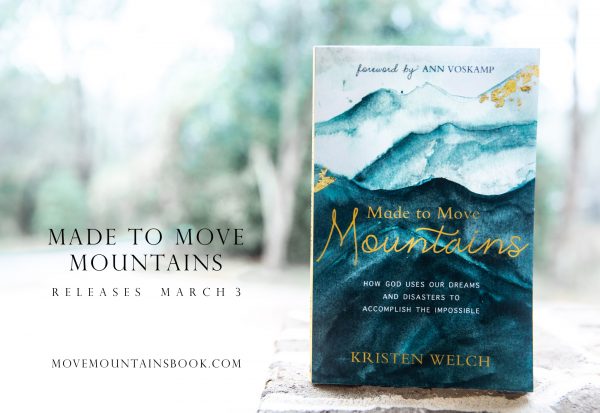
The reason I’m writing about this today in particular is that Kristen has a new book out that I want to recommend to you as well: Made to Move Mountains: How God Uses Our Dreams and Disasters to Accomplish the Impossible. In this book, Kristen shares very honestly about what it’s been like to deal with the “impossible” challenges of running an often heartbreaking ministry like this…and how God has met their needs. It’s also a very personal book, as she talks about the toll serving has taken on her family and her marriage, and how God has brought them through even when it’s felt overwhelming. There’s no tidy ending, which I love, because life rarely has tidy endings. It will convict you, move you, encourage you, and help you think in fresh ways about the mountains of dreams and disasters in your own life.
Kristen has provided the following excerpt from the book to share here. I hope you’ll enjoy her insights and and I highly recommend getting a copy. Continue reading
For Valentine’s Day last year, my husband and I exchanged
notes with fifteen affirming words that describe one another. One of the words
my husband chose for me included a qualification: “Adventurous (unless there’s
danger).” When I first saw it, I thought he was joking. How adventurous can a
person be if there’s no danger? But he defended his questionable choice of a
compliment by clarifying that he loves how I embrace the idea of adventure, even if I eventually panic when doing something.
One case in point: scuba diving. Before my husband and I had
kids, we decided to get scuba certified. To do so, you start by taking classroom
lessons. It was in those lessons—before my big toe had even touched the
water—that I started having second thoughts. The complexity of diving even
caused my normally fearless husband to have some trepidation.
Nonetheless, we continued, and there was one lesson we still
laugh about today. The book said something like this: “Before you get to the
dive site, discuss the dive objective with your buddy. If you’re planning a
photography dive but your buddy is planning a trash clean-up dive, the two of you
will bring very different tools and want to do very different things.”
Trash clean up? Photography? Our only objective as dive buddies was to not drown. The idea that the two of us would ever get to a point
where I might show up to the boat with a litter grabber, only to have my hopes
dashed by my husband revealing an exciting new dive camera was ridiculously
funny. For years now, whenever we need to make sure we’re on the same page
about something, we say, “OK, I was just making sure you weren’t planning to
pick up trash while I was planning to photograph a lobster.”
One of the greatest barriers to civil conversation between
people with different worldviews is when they don’t stop to determine whether
they have the same objectives in mind.
Oftentimes, they think they’re
on the same page—“Hey! We both want to scuba dive!”—but in reality, one group
means they want to pick up trash and the other means they want to do underwater
photography. Love is one of the most common subjects where this happens today.
I was scrolling through Facebook recently when I saw an
article that stopped me in my tracks: “5 Things People with Tidy Homes Don’t
Do.”
Oh boy. This is one I need to read. Immediately.
I am constantly fighting a messy house. Whenever I take my kids to a friend’s home, I’m amazed at how relatively clean it is. How do they not have a pencil on every seat cushion? How do they not have returned homework papers carelessly scattered across the floor? How do they not have sticky spots on their counters and stacks of mail stuck to the sticky spots? What do these parents know that I don’t?
The article I clicked on that day provided a tantalizing clue to
the answer. The author wrote:
Tidy People don’t act like a slob all day, and then get their house tidy in one fell swoop. . . . The number one thing I’ve learned from Tidy People is how valuable it is to develop some simple, non-drastic, tiny habits that when added together will change the level of tidiness in your home. Tidy People are in a constant state of low-grade tidying.
Low-grade tidying. The
point hit me like a ton of bricks (which, if they were in my house, would be
all over the floor, and we’d continue to step over them for weeks before
someone moved them outside). You see, my running assumption had been that I
must have particularly messy kids. But I’ve since come to realize
that—gasp!—the vast majority of kids are quite messy. Those clean houses I
visit aren’t the product of naturally clean kids. They’re the product of
parents with good habits—parents who are constantly in a state of low-grade
tidying.
Today on the Focus on the Family radio broadcast, president Jim Daly and co-host/VP John Fuller interview me on answering your kids’ tough faith questions! The interview is based on my first book, Keeping Your Kids on God’s Side. You can hear it on local radio stations, watch it on YouTube (embedded at the end of this post), or listen on a podcast app. If you don’t already have a copy of Keeping Your Kids on God’s Side, you can get one from Focus on the Family for a gift of any amount! Check out this page for more information and related resources.
This is the second interview I’ve done with Focus on the Family. The first one aired last January and turned out to be one of their most popular of the year! They re-aired it at the end of December as one of their “Best of 2019.” That one was based on my second book, Talking with Your Kids about God. If you missed it, I’m embedding that interview from YouTube below as well.
Finally, on a side note, I’m considering creating some of my own short videos this year on the same types of subjects as you read about here on my blog. They wouldn’t replace what I write here (I’ll always primarily be an author at heart!), but would possibly be in addition to it. I’ve created a YouTube channel where I would put that content. If you’re interested, click here to subscribe to my channel. Although I haven’t created any videos there yet, I’ve made two playlists of various interviews I’ve done with others. Be sure to check those out!
[UPDATE 1/10/20: DUE TO THE LARGE NUMBER OF APPLICANTS, THE LAUNCH TEAM APPLICATION CLOSED EARLY! Thank you so much to those who have applied. You will be notified by email the week of January 13 if you’ve been accepted for the team.]
A launch team is a group of people who are excited about the release of a new book, want the opportunity to read it before anyone else, and are willing to help the author spread the word when it comes out. That’s the basic idea, but read on for details!
What You Get
As a launch team member,
you’ll receive the following:
A FREE physical copy of the book before release day (US continental addresses only).
A digital version of the book THIS MONTH—three full months before it’s publicly available (this is for both US and international launch team members)!
Membership in a private Facebook group with me and the rest of the launch team, where we’ll read through the book together and collaborate on promotional ideas. You’ll have the opportunity to make new friends with like-minded parents, have great discussions about raising kids to know and love the Lord, win cool prizes, and ask me any questions you’d like.
The unique behind-the-scenes experience of launching a new book into the world! If you’re interested in writing a book yourself someday or just think it would be interesting to see how books are launched, this will be a great opportunity.
You
already know the world will challenge your child’s faith in Jesus. But do you
know specifically what those faith challenges are, how to effectively talk with
your child about them, and what that means for you as a Christian parent on a
day-to-day basis?
If
your answer is no, you’re not alone. Many Christian parents feel the same.
But here’s the good news: Talking with Your Kids about Jesus will give you the confidence you need to have the conversations that matter most in today’s skeptical world. In a friendly, parent-to-parent voice, Natasha Crain will walk you through thirty essential topics on Jesus’s identity, teachings, death, and resurrection. Each chapter clearly explains what skeptics are saying and provides a concise, easy-to-understand response you can discuss with your child—one that can be tailored for any age.
Endorsements
I’m so honored that Lee Strobel wrote the foreword for this book! Here’s a snippet of what he had to say, and a couple of other sample endorsements. (The book contains additional endorsements from Pam Farrel, Bobby Conway, Amber Lia, J. Warner and Susie Wallace, Jack Hibbs, Frank Turek, Alisa Childers, Bill Martin, Mark Mittelberg, Hillary Morgan Ferrer, Ron Hunter, Jr., and Arlene Pellicane. I’m so grateful for all of these endorsers!)
“Natasha has an uncanny combination of a warm and winsome writing style, keen insights born out of personal experience, and a wealth of knowledge about evidence for the faith. Natasha is a trusted source for parents who want to provide their children with a vibrant and well-informed belief in Jesus.”
—Lee Strobel,
bestselling author of The Case for Christ and The Case for Faith
“Natasha Crain reminds us how important it is to integrate conversations about faith into our everyday lives with our sons and daughters. This compelling resource will equip you to point your child to the truth of Jesus’s life, death, and eternal reign.”
—John Fuller, vice
president of Focus on the Family and cohost of the Focus on the Family radio
broadcast
“When it comes to learning how to communicate with kids about God, I turn to Natasha Crain. She’s funny, relatable, and most important, deeply rooted in the Bible. Talking With Your Kids About Jesus is part of a series of books (you need to get them all) that is soaked in Scripture and awash with powerful evidence, fantastic examples, and thought-provoking discussion questions. It’s so sneaky the way Natasha gets me thinking more deeply about my own faith as I learn how to help my kids deepen theirs.”
—Jeff Myers, PhD, president, Summit Ministries, and author of Unquestioned Answers: Rethinking Ten Christian Clichés to Rediscover Biblical Truths
So how does Talking with
Your Kids about Jesus relate to my prior two books?
I realize that if you just take a quick look at the titles of my three books without seeing the tables of contents, they might sound similar. But they’re completely different in content and are intended to be a complementary set of tools to have as a Christian parent.
Keeping Your Kids on God’s Side introduces parents to 40 of the most important faith challenges facing Christian kids today across a broad range of subject areas (God, truth and worldviews, Jesus, the Bible, and Science). Think of it like an “apologetics 101” for Christian parents. You can see a full table of contents here.
Talking with Your Kids about God explains 30 key subjects specifically about God that kids need to understand in today’s increasingly atheistic world (for example, evidence for his existence, the relationship between science and faith, the nature of God as revealed in the Bible, etc.). You can see a full table of contents here.
Talking with Your Kids about Jesus now explains 30 key subjects specifically about Jesus that kids need to understand in today’s increasingly skeptical world. The table of contents is below. One thing unique to this book is that, given the nature of the focus on Jesus, there’s a lot of theology AND apologetics (whereas prior books were inherently focused on apologetics). There’s a lot of bad theology out there today when it comes to Jesus, and this book will help you sort through many “progressive” ideas infiltrating the church.
If you haven’t already read both of my prior books, you might be wondering where to start. There’s no need to read any particular book before another. You can read them in any order.